Should Your Player Play Up in Travel Baseball?

When Older Competition Helps Development and When It Can Hurt Confidence
One of the biggest debates in travel baseball is whether players should “play up” above their age division.
Parents hear it constantly:
“He needs tougher competition.”
“She’s too advanced for this level.”
“Elite players always play up.”
Sometimes that advice is absolutely correct.
Sometimes it is not.
As both a coach and a parent, I have seen players thrive against older competition and I have also seen players lose confidence because the jump happened too early. The truth is that playing up is not automatically better for development. It depends entirely on the player, the environment, and the reason behind the move.
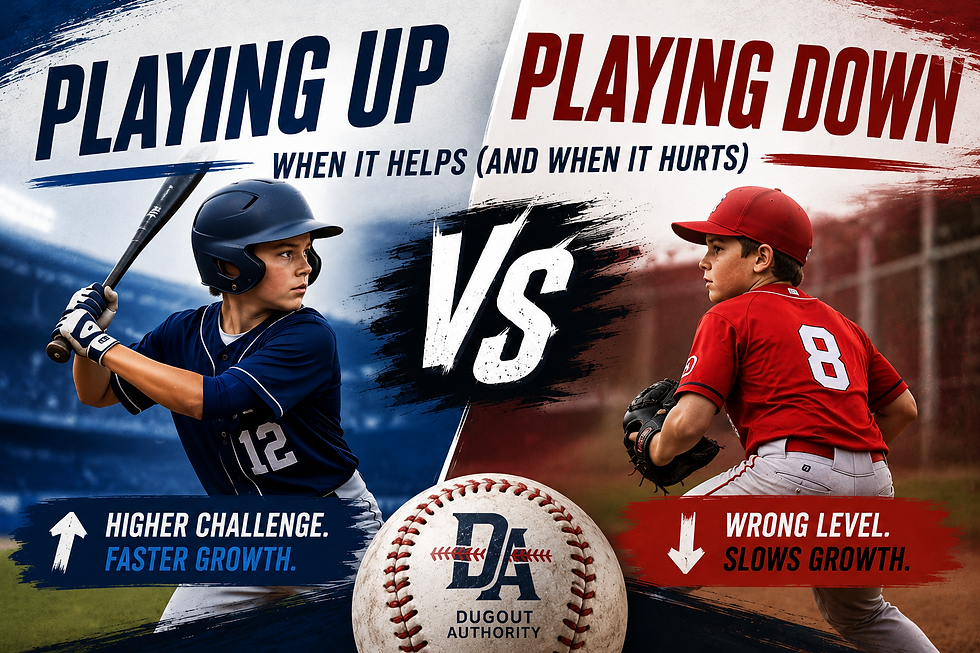
What Does “Playing Up” Actually Mean?
Playing up simply means competing above your age division.
Examples:
a 10U player joining an 11U roster
a 12U player guest playing with 13U
a freshman competing on an older showcase team
The idea is usually to challenge players with:
faster game speed
stronger competition
older athletes
more advanced baseball IQ
And sometimes that challenge creates huge growth.
When Playing Up Helps Development
For the right player, older competition can accelerate development in several ways.
The game speeds up quickly. Pitching is sharper, baserunners are faster, and mistakes get exposed more consistently. Players often improve because they are forced to:
think quicker
adjust faster
compete harder
play with more focus
One of the biggest benefits is mental development. Older competition can build resilience, composure, and baseball IQ much faster than dominating younger competition repeatedly.
Players who are physically advanced, emotionally mature, and already succeeding comfortably at their age level often benefit the most from moving up.
Confidence Still Matters
This is the part many families underestimate.
A challenge only helps development if the player can still compete confidently.
If a player constantly feels:
overwhelmed
physically overmatched
discouraged
afraid to fail
development can actually slow down.
Confidence impacts everything in baseball:
swings
pitching
aggressiveness
decision making
mental toughness
The healthiest development environments usually balance challenge with success. Players should feel pushed, but not defeated.
Physical Maturity Changes Everything
At younger ages especially, physical gaps matter a lot.
An older team may simply be:
stronger
faster
more physically developed
even if the younger player is highly skilled.
This becomes especially important for pitchers. Facing older hitters can increase:
stress
workload
fatigue
injury risk
Youth Baseball Pitching Safety Guide discusses why recovery and workload management become even more important once competition intensity increases.
Sometimes players are technically ready to play up but not physically ready yet.
Playing Down Is Not a Failure
This is a huge misconception in travel baseball culture.
Many families feel pressure to constantly chase older competition because social media often treats “playing up” like proof a player is elite.
But staying age appropriate is still completely healthy for development.
Most players benefit from:
building confidence
mastering fundamentals
developing steadily
learning the game properly
There is nothing wrong with growing at the correct pace.
In fact, many successful high school and college players never aggressively played up at younger ages.
Coaches Usually Look at More Than Talent
Good coaches evaluate:
maturity
confidence
consistency
physical readiness
emotional resilience
before moving players up.
Talent alone is rarely enough.
Because older competition becomes mentally demanding very quickly. Players need to handle:
failure
pressure
faster game speed
tougher environments
without losing confidence in the process.
The Best Development Happens in the Right Fit
The best baseball environment is usually not the one with the flashiest label.
It is the environment where players are:
challenged appropriately
continuing to improve
competing confidently
still enjoying the game
For some athletes, that means playing up.
For others, it means dominating their age level first before gradually increasing competition over time.
There is no universal timeline for baseball development.
Final Thoughts on whether Your Player should Play Up in Travel Baseball
Playing up in travel baseball can absolutely help the right player grow faster. Older competition often improves baseball IQ, toughness, and adaptability.
But harder competition is only beneficial when players can still:
compete confidently
develop steadily
enjoy the game
Because ultimately, long term baseball development is not about chasing labels or impressing social media.
It is about helping players:
stay healthy
build confidence
improve consistently
continue loving baseball year after year. ⚾